
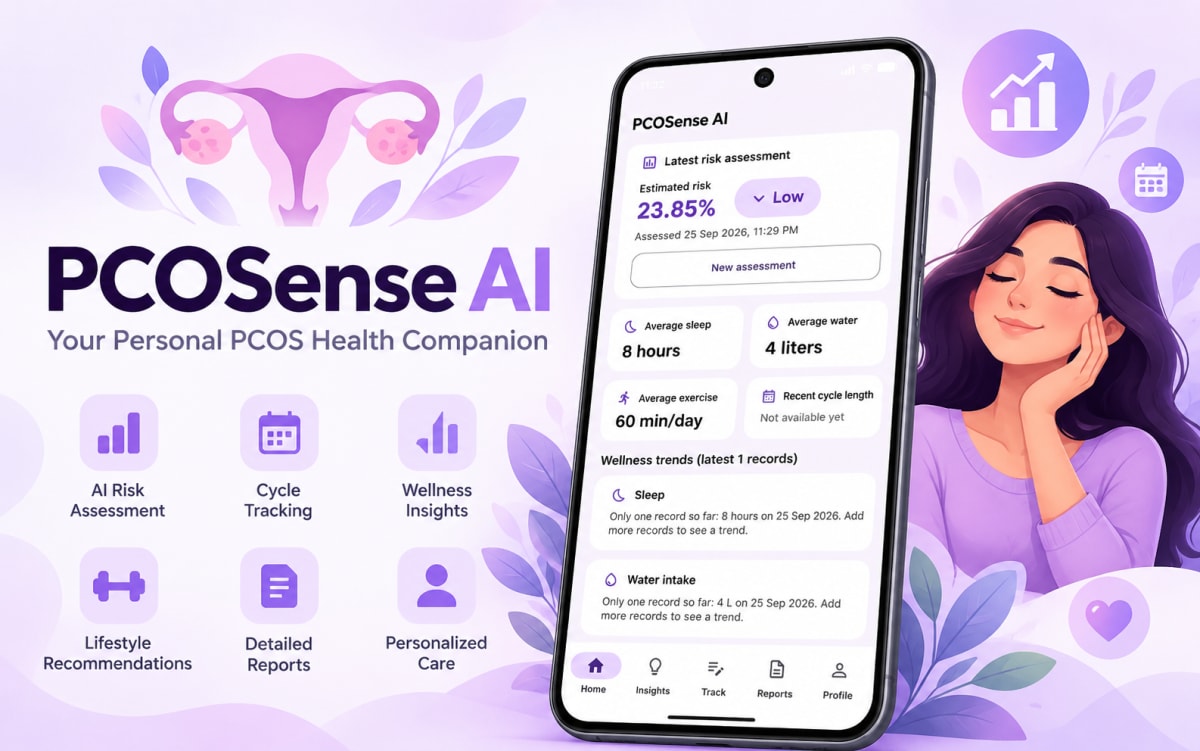
PCOSense AI – An AI-Powered Wellness and PCOS Risk Assessment System
AI-powered wellness tracker for PCOS risk assessment, insights, and health monitoring.
Project overview
What this project is about.
PCOSense AI is an AI-powered wellness and PCOS risk assessment application designed to help users understand and track their wellness information in one place. The application combines Machine Learning, health data tracking, menstrual cycle tracking, personalized insights, and reports through an easy-to-use mobile interface.
The system allows users to create an account and maintain a basic health profile containing information such as age, height, and weight. The application automatically calculates BMI from the available profile information.
The main feature of PCOSense AI is its Machine Learning-based PCOS risk assessment. Users provide selected health and symptom-related information such as menstrual cycle regularity, cycle length, weight gain, hair growth, skin darkening, hair loss, and pimples. The application sends these details to the Django backend, where a trained Logistic Regression model processes the information and generates an estimated PCOS risk probability and risk category.
The system does not diagnose PCOS. Instead, it provides an ML-based risk assessment intended for educational and academic purposes. The application clearly communicates that the results are not a medical diagnosis or medical advice.
PCOSense AI also provides a wellness tracking system where users can record daily information such as sleep hours, water intake, exercise duration, mood, and stress level. This information helps users maintain a history of their wellness activities and understand their personal tracking patterns.
The application includes menstrual cycle tracking, allowing users to record cycle start dates, end dates, cycle length, flow information, symptoms, and notes. Users can review their previous cycle records and manage their tracking history.
Based on the user's assessment, wellness records, and cycle data, the system generates simple rule-based insights and recommendations. These insights can highlight tracked patterns such as low exercise, insufficient water intake, high stress, sleep patterns, or difficult moods. The system avoids making medical diagnoses or unsupported medical claims.
A centralized dashboard brings important information together, including the latest PCOS risk assessment, assessment history, recent wellness records, wellness trends, menstrual cycle information, and generated insights. This allows users to view their tracked information without navigating through multiple screens.
The application also provides a report-generation feature that creates a wellness and risk assessment report containing relevant profile, assessment, wellness, cycle, and insight information. This report can be viewed or shared from the mobile application.
The backend is developed using Python, Django, and Django REST Framework. It provides REST APIs for authentication, user profiles, PCOS risk assessment, assessment history, wellness tracking, menstrual cycle tracking, insights, dashboards, and reports. JWT-based authentication is used to protect user-specific API access.
The machine learning component uses a Logistic Regression model trained on a publicly available PCOS dataset. The trained model is stored separately and loaded by the Django backend when an assessment is requested. The backend validates the input data before passing it to the model and returns the prediction through a REST API.
The mobile application is developed using Flutter and communicates with the Django REST API using Dio. Provider is used for application state management, while Flutter's PDF and printing packages are used for report generation and handling.
PCOSense AI is designed as an academic and demonstration project that combines Artificial Intelligence, Machine Learning, mobile application development, REST APIs, authentication, data tracking, and reporting into a single application. It demonstrates how machine learning can be integrated with a practical wellness tracking system while keeping the prediction clearly separated from medical diagnosis.
Key features
- ML-based PCOS risk assessment
- Estimated risk probability and risk category
- User profile and BMI calculation
- Wellness tracking
- Sleep tracking
- Water intake tracking
- Exercise tracking
- Mood tracking
- Stress-level tracking
- Menstrual cycle tracking
- Cycle history management
- Personalized wellness insights
- Assessment history
- Interactive dashboard
- Wellness and assessment trends
- Risk assessment reports
- JWT-based authentication
- Secure password management
- User-specific data isolation
- Mobile-friendly Flutter application
Technology stack
PythonDjangoDjango REST FrameworkFlutterDartSQLiteScikit-learnPandasNumPyJoblibLogistic RegressionJWT AuthenticationDioProviderFL ChartReportLab / PDFHTMLCSSJavaScript
Usage and use case
1. Create an account and securely log in to the application.
2. Complete the basic profile with age, height, and weight information.
3. Enter the required symptoms and health indicators for PCOS risk assessment.
4. Generate an ML-based PCOS risk assessment and view the estimated risk category.
5. Track daily wellness information such as sleep, water intake, exercise, mood, and stress.
6. Record menstrual cycle information including dates, flow, symptoms, and notes.
7. View personalized insights generated from assessment, wellness, and cycle data.
8. Monitor assessment history and wellness trends through the dashboard.
9. Generate and view a downloadable wellness and risk assessment report.
10. Update profile information and manage account security settings.
Requirements
Python 3.x
Django
Django REST Framework
Flutter SDK
Dart SDK
Android device or emulator
Android SDK Platform-Tools
SQLite
Scikit-learn
Pandas
NumPy
Joblib
Project add-ons
Additional add-ons for this project.
Ask about project-specific add-ons through the ProjectVybe enquiry channel.
Documentation support
Create clear, well-structured project documentation covering implementation, technologies, features, methodology, and project outcomes.
Presentation support
Prepare professional project presentations that clearly explain your project idea, workflow, technologies, implementation, results, and key highlights.
Publication support
Get guidance in preparing and structuring project work for technical papers, research publications, and academic submission requirements.
1:1 mentorship
Get personalized guidance from project planning and technology selection to implementation, debugging, documentation, and final presentation.
Frequently asked questions
Questions about this project.
How can I ask about this project?
Use the enquiry button to share the project context and the kind of support you are looking for. ProjectVybe will review the enquiry and respond directly.
Is a demo available?
A YouTube demo has not been added for this project yet.
Can I request changes or additional support?
Yes. Describe your requested changes or learning goals in an enquiry so the ProjectVybe team can review them.
Are project add-ons available?
The available project add-ons are listed above and can be selected when you send an enquiry. Add-ons are enquiry-based; no online checkout or public pricing is provided.
How do I get started?
Review the project information, then use the enquiry button to send the details you would like to discuss.

FraudShield AI — Intelligent Credit Card Fraud Detection & Transaction Monitoring
AI-powered web application that detects credit card fraud using a trained XGBoost machine learning model.
View project
TrafficMind AI — Smart Traffic Analytics & Optimization
Upload traffic media, detect vehicles, estimate lane congestion, and simulate adaptive signal timings with YOLOv8.
View project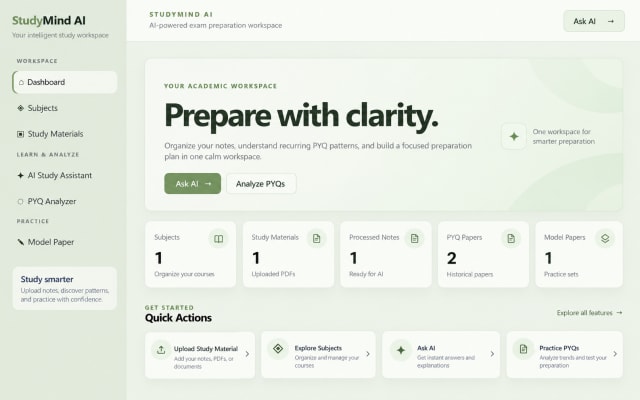
StudyMind AI — An intelligent platform for personalized exam preparation.
AI-powered exam preparation platform that organizes notes, analyzes PYQs, and generates personalized practice papers intelligently.
View projectBuild. Learn. Grow.
Ready to discuss this project?
Send ProjectVybe the project context you are exploring, or continue browsing the published catalogue.